
Decide what makes an AI answer usable
A practical evaluation card for checking facts, missing information and commitments before a person decides whether to use an AI draft.
An AI draft arrives, the sentences read well, and someone asks whether it is good enough to use. Before testing a pilot, we recommend answering a more specific question: what would the reviewer need to check before passing this result to the next person?
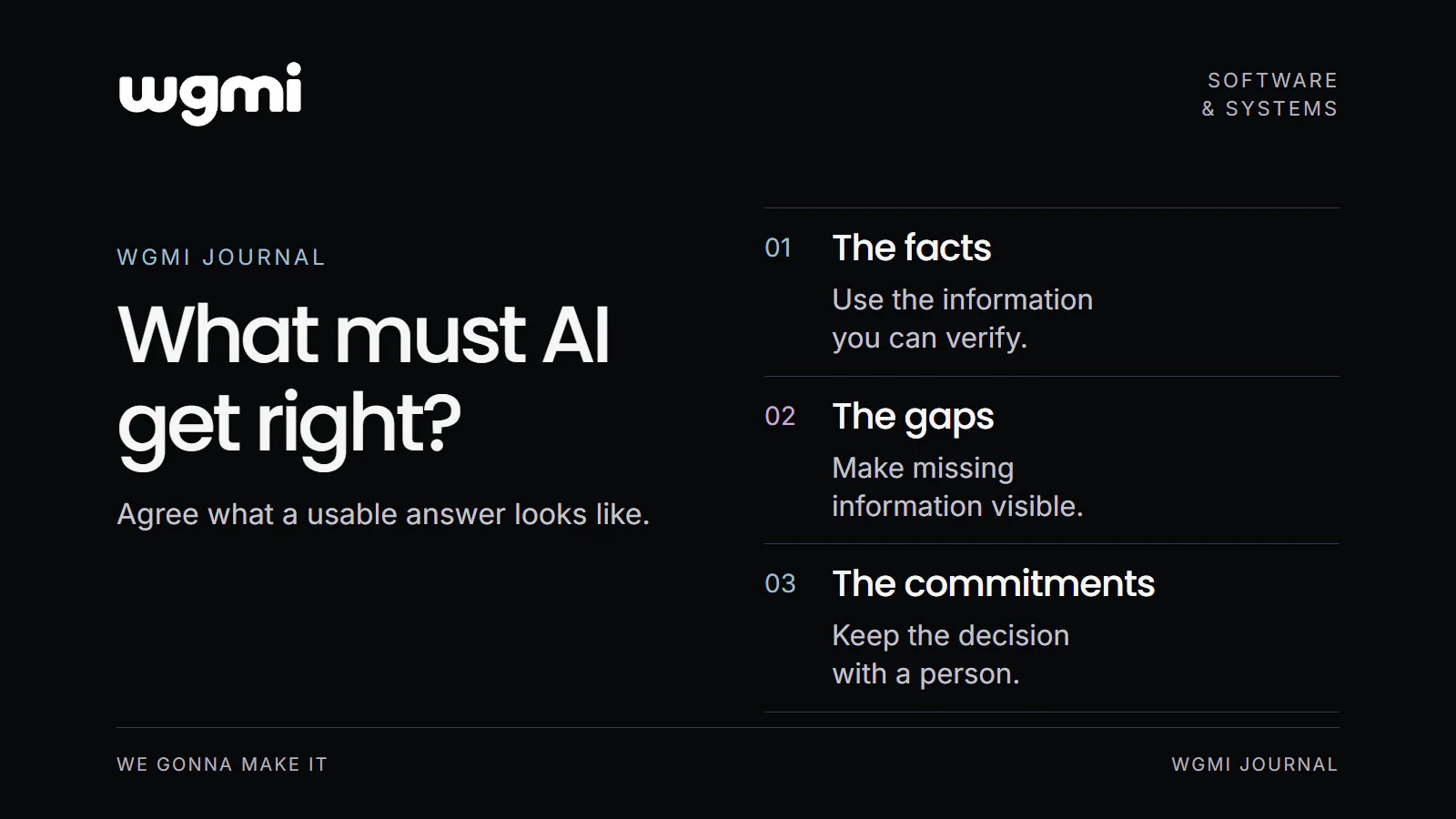
For a proposal, our suggested starting point is four checks: facts match approved inputs, missing information is named, numbers and commitments have approval, and a person owns the final decision. A fluent paragraph cannot replace any of those checks.
Start with the job the answer must do
Use one defined task. In this illustrative example, the job is to prepare a proposal draft from an enquiry and approved service wording. It is a fictional scenario, not a client result. The draft can organise the supplied information and mark unresolved details. The reviewer remains responsible for agreeing scope, price and delivery before sending it.
That boundary makes evaluation concrete. The question becomes whether this particular draft is ready for review against the inputs, rather than whether AI is generally useful.
The source pack also needs a boundary. For this example, it contains an anonymised enquiry and an approved template. A previous proposal can supply approved wording only where it still applies. Its old price and delivery date are not permission to reuse those commitments.
Define four checks before the trial
1. Facts agree with the source
The reviewer compares the draft with the supplied material. The requested work, customer requirements and quoted figures should be traceable to an input. An unsupported statement returns to correction. A reviewer who cannot find its source records that uncertainty instead of assuming the statement is correct.
2. Missing information stays visible
An unanswered question belongs in a gap list. If the enquiry has no launch date, the draft should say that the date needs confirmation. Naming the missing detail and the person who can resolve it gives the reviewer a next step. Quietly choosing a plausible answer does not resolve the gap.
3. Commitments have an owner
A proposed price, delivery date or scope promise requires approval from the responsible person. For this trial, an invented commitment is a reason to return the draft, however good its other sections are. Do not average that failure away with a high score for tone or formatting.
4. A person makes the decision
The reviewer records whether the draft can proceed, needs correction or must wait for information. Passing a check does not authorise the tool to send the proposal. Sending remains a separate decision with a named owner.
A worked failure
In our fictional enquiry, a customer requests a website but gives no launch date. The draft says, "We will deliver next month."
The review record should identify the unsupported date, point to the missing input and return the sentence for correction. A replacement could read, "Delivery date: to be agreed after scope review." The proposal still needs the responsible person's review. The replacement makes the uncertainty visible; it does not settle the schedule.
Keep an evaluation card beside each draft
This suggested card can sit in the same document as the output:
Task: What should this draft help someone do?
Inputs checked: Which source documents and versions were used?
Facts: Which statements were checked, and against what?
Gaps: What is unknown, and who can answer?
Commitments: Which numbers, dates or promises need approval?
Decision: Proceed to the next human step, correct, or wait?
Owner and reason: Who made that decision, and why?
Keep the original output and the corrections together. During a trial, use several examples, including one with missing information and one with conflicting inputs. Record corrections and review effort. Those observations can inform a decision to continue, adjust or stop; they do not establish a guaranteed saving.
WGMI's AI Partner service describes this approach to human review: someone checks facts, figures and commitments before using or sending a result. Scope, setup and team participation are agreed for the task.
For one recurring task, complete the evaluation card above before your next trial.
Prepared for WGMI with AI assistance.