
Give your pilot a boundary before it starts
DOLFA's development plan opens a practical question for any proposed pilot: which workflow, people and test material are in scope, and when will you pause?
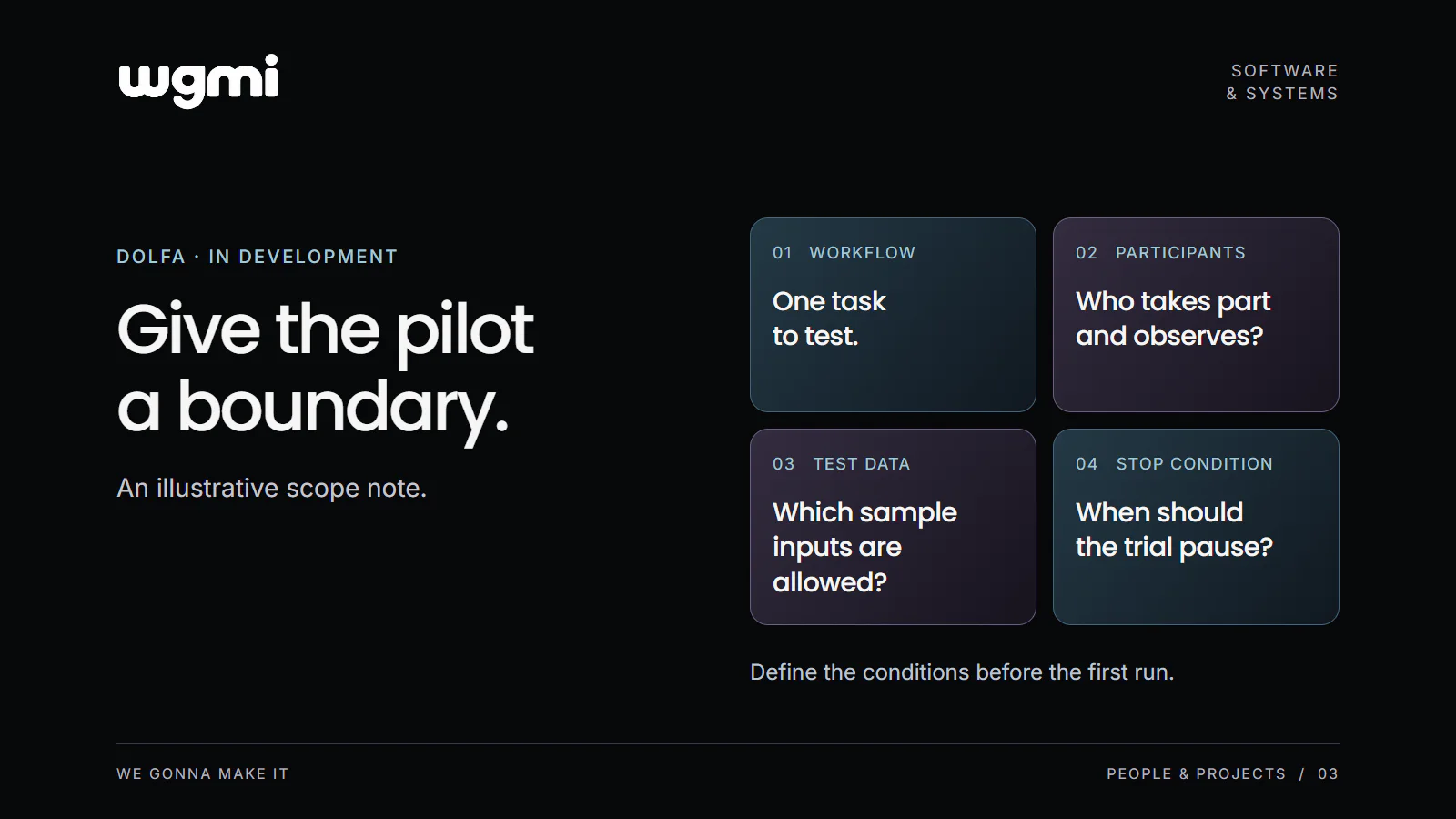
What would make you stop a pilot? It is a useful question to answer while the trial is still a plan. Before people are invited or records are added, you can decide which workflow to test, who will take part, what material they will use and what would cause the exercise to pause.
Our suggested brief starts with those four boundaries and ends with one decision the trial should inform. This makes the scope available for discussion before enthusiasm turns a small exercise into a larger commitment.
A project that makes the boundary visible
DOLFA is one of our projects, a medical workspace in development for private doctors and small clinics. Its early development plan uses synthetic data. That boundary gives us a useful planning question: what belongs inside an early trial, and what would require a separate decision?
A product direction explains what we want to build. A trial plan names what a defined group would examine next and the evidence they would bring back. Readers considering a trial of their own can use the same four boundaries below.
For this article, we will use a fictional equipment booking exercise outside clinical work. It makes the structure of a bounded trial easier to inspect.
Write the question first
Imagine a team considering a new way to handle equipment booking requests. The trial question is: can the coordinator identify a request with a missing return date and send it back for clarification?
That is narrow enough to examine in one session. It also gives the team a concrete decision afterward. They can keep the proposed clarification step, revise it or stop testing it. A question such as "Does the whole system work?" would leave much more room for disagreement about what was actually tested.
Give the exercise four boundaries
Workflow. The fictional exercise starts when a prepared equipment request is opened and ends when it is marked as needing clarification. Finding equipment, approving expenditure and sending real messages sit outside this session. Those tasks could be considered separately if the team later chooses to expand the trial.
Participants. Two participants and an observer take part. One participant acts as the requester, the other as the coordinator. The observer records what they do and decides whether the exercise should pause. Each person knows the part they will play before the session begins.
Test material. The group uses a small set of made up names, equipment labels and dates prepared for the exercise. One request deliberately lacks a return date. Another contains all the information required by the proposed process. No existing customer or operational records are needed for this example.
Stop condition. If someone needs real records, another participant or a connection to a live service to finish the task, the observer pauses the exercise. The group then reviews the scope before continuing. A pause records a boundary that needs attention; it does not decide whether the entire product should be abandoned.
Record the moment the plan becomes unclear
During this hypothetical session, the observer could note which request the coordinator opened, whether the missing date was recognised and what happened next. If the coordinator cannot find a way to request clarification, the record should describe that point precisely.
For example: "The return date was missing. The coordinator looked for a clarification action and asked the observer what to do." This is an invented observation to show the level of detail we suggest, not a measured finding.
That record gives the team a specific part of the proposed workflow to revise. The next session can concentrate on the clarification action and check whether the revised step is understandable.
End with a decision about the next step
For the fictional exercise, the closing note would contain the trial question, what was observed, any boundary reached and the decision to keep, revise or stop testing the step. If the group wants to add another workflow, it writes a new scope before the next session.
This is a planning exercise you can use when considering a pilot of your own. It keeps the proposed work visible enough for participants to question and change it before they begin.
Write the workflow, participants, test material and stop condition for one pilot you are considering.
Prepared for WGMI with AI assistance.