
Keep the reason with the decision
Give a future colleague the reasoning behind a project choice with a short note covering the decision, its reason, the alternative and a condition for reconsidering it.
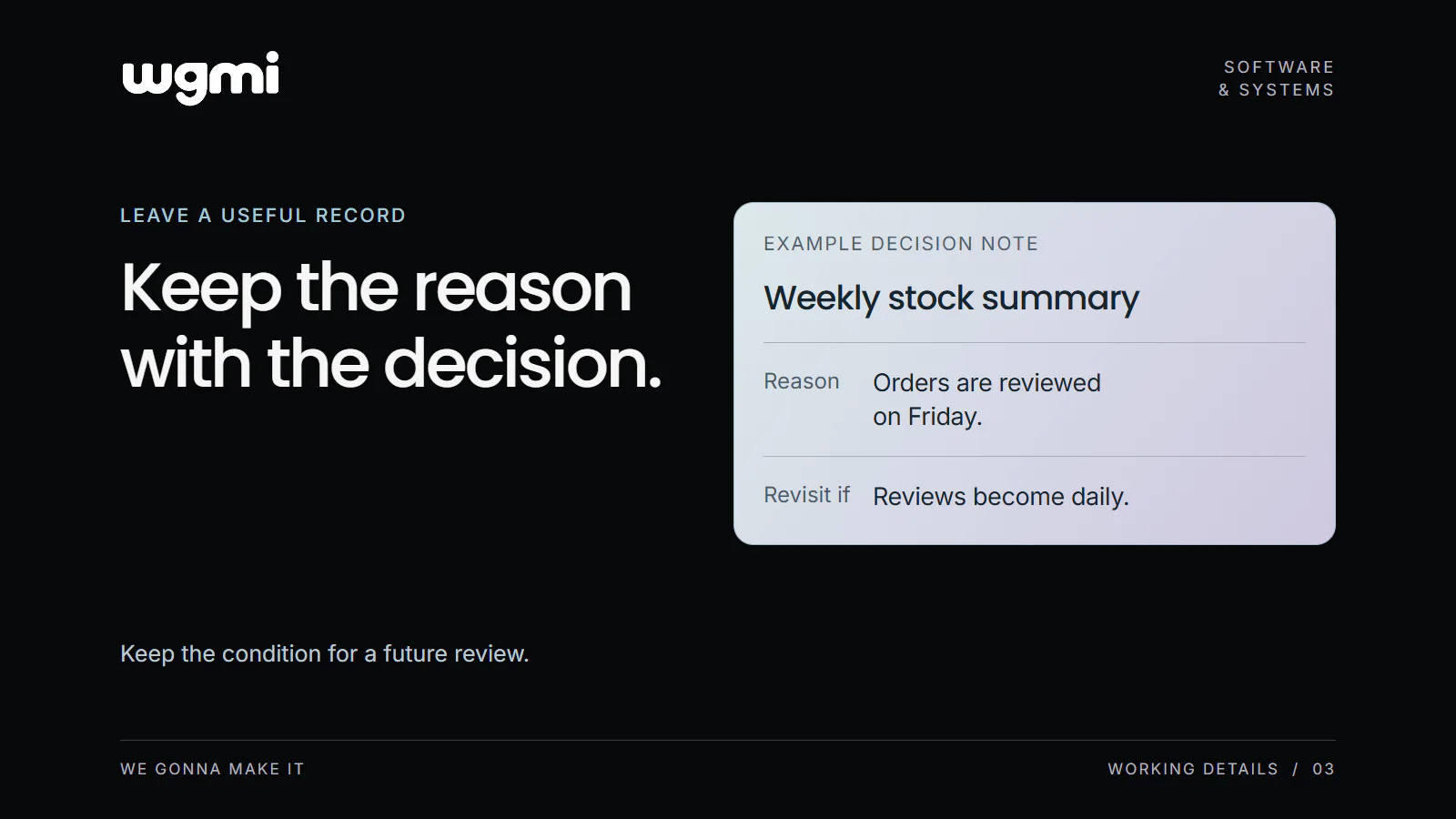
Imagine handing a project to a colleague who was not in the room when you made its early decisions. They find an instruction to prepare a weekly stock summary. The instruction is clear. The reason for choosing a week is missing.
Our suggested decision note keeps that reason beside the choice. It also records the alternative considered and a condition for another look. These four parts give the next person something specific to examine when the work changes.
A complete note in four parts
The following example is fictional.
Decision: Prepare a weekly stock summary for the purchasing review.
Reason: Purchasing reviews happen every Friday. The summary is intended to inform that meeting.
Alternative considered: A daily summary. We have not chosen it because this example has no daily purchasing review.
Revisit if: The purchasing review moves to a daily schedule.
The note connects a reporting choice to the business activity it supports. A future colleague can see what the report was intended to help with and which condition would reopen the question.
Give the reason something to refer to
A reason such as “it is more efficient” leaves the next reader guessing. In our example, the reason names a particular meeting and explains the report's purpose. It can be checked against how purchasing reviews actually work at that point.
The note covers the summary prepared for one review. Keep that scope in the decision itself so the next reader knows which part of the work the note covers.
There may be several reasons for a real decision. The short note should retain the ones that could change the choice. A long account of every conversation is optional; the condition the decision relies on is central.
Record the alternative fairly
The daily summary remains a possible option in the example. The note explains why it was not selected for this particular review schedule, leaving a future colleague room to reconsider it.
That distinction matters when writing your own note. “We considered a daily report” and “we tested a daily report” make different claims. If an alternative was discussed but never tried, the record should say so. A later colleague can then decide what still needs investigation.
The alternative also makes the decision easier to interpret. The team chose between reporting frequencies for an existing purpose. It did not decide whether every other part of the purchasing process should remain unchanged.
Make the revisit condition observable
“Review this when necessary” gives little direction. In the example, a move to daily purchasing reviews is a recognisable change. Someone can point to the new schedule and explain why the earlier choice deserves attention.
If the review schedule changes, check whether the report should change too. The team would need to examine what information the new review requires, whether the existing summary provides it and what preparation is feasible. Those checks become the basis for the next decision. The earlier note provides a starting point and a reason to ask again.
If the choice changes, retain the earlier note and record the replacement with its new reason. Mark which decision is current so that a future reader can follow the sequence without treating both as active instructions.
Leave a usable record
At WGMI, Discovery & Roadmap includes options, tradeoffs and a written roadmap. This short note is a suggested way to carry the reasoning into a plan that someone else will use later. It is useful when a choice depends on a condition that could change. It does not replace the fuller evidence a consequential decision may need.
Write these four lines for one decision you will pass to a colleague: what you chose, why, which alternative you considered and what would make you reconsider.
Prepared for WGMI with AI assistance.