
Look for the work behind the screenshot
Use a small example from WGMI's own journal to ask three useful portfolio questions: what was the task, what did the team contribute and what can you inspect?
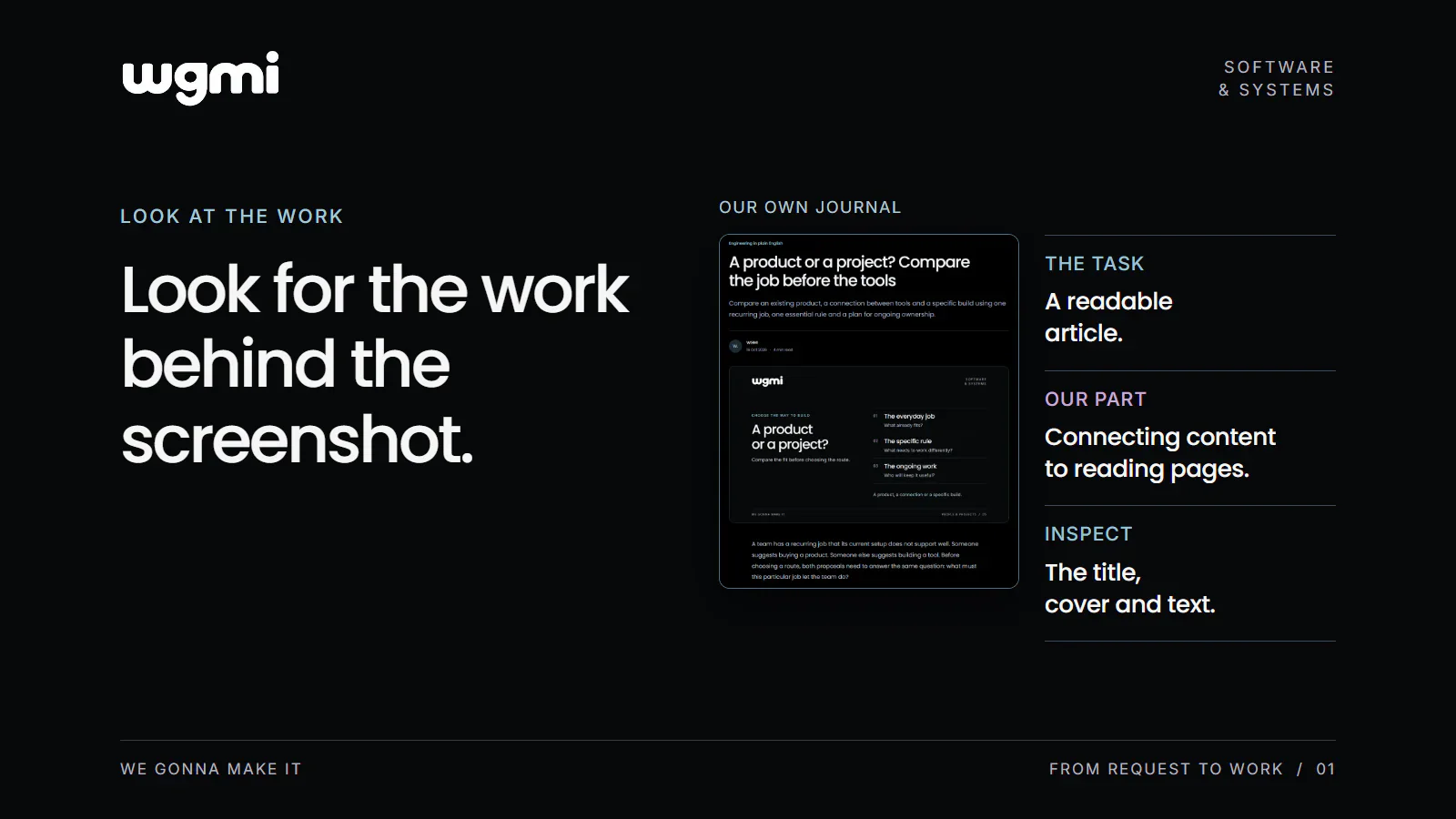
You are choosing a team for a website or a working tool. Their portfolio contains a polished screenshot. It gives you a useful first impression, but you still need to understand what the team was responsible for and which part of your own problem that example addresses.
Our suggested approach is to ask for three things together: the task, the team's exact contribution and something you can inspect. That keeps the conversation close to the work you are considering.
Start with a small example you can identify
For our own WGMI journal, one example is the article page for A product or a project?. A reader can open a named article, see its cover and text, and return to the journal. It is a specific piece of our own website work that we can discuss without borrowing a client's story.
The task behind this example is to give published editorial content a readable public page. The reader needs to recognise the article, follow its text and find a route back to other articles.
A screenshot shows part of that presentation. Opening the page adds an opportunity to inspect how the title, cover, body and navigation work together.
Name the contribution
Our part in this example is the WGMI article presentation and its connection to published journal content. The implementation maps the article's title, cover and structured body into the public page, alongside its author and publication information.
That is a useful scope to name. It tells a potential partner what they can discuss with us about this particular artifact. It also gives the next question somewhere to land: which part would matter for the site or tool they want to build?
For another portfolio example, the contribution could be different. A team might have designed the interface, built one integration, produced the motion work or maintained an existing application. Naming the contribution makes the example easier to assess.
The same care applies when several teams were involved. A clear explanation of one team's part gives a buyer a more precise subject for a conversation than a broad project label.
Match the evidence to the question
If you want to discuss the article's presentation, the public page is a relevant place to look. You can read it at the width your audience will use, inspect the cover and follow the route back to the journal.
If your question concerns the editing process, ask for a demonstration of that process. A public reading page does not show which controls an editor uses or who is allowed to publish. The evidence needs to follow the question.
You can also ask which version or environment you are seeing. A prototype, a test environment and a current public page can each support a useful discussion when their purpose is clear. That label helps everyone understand what the example establishes.
Keep any demonstration proportionate. A team can explain a workflow using sample content while protecting information that belongs to another customer.
Put the example in a short evidence note
For the WGMI journal example, the note could read:
Task: Give a published article a readable public page.
Our part: The article presentation and the connection from published journal content to that page.
Inspect: Open the named article, review the title, cover and body, and follow the route back to the journal.
Further question: If your project also needs an editorial workflow, ask to examine that workflow separately.
This gives the screenshot a clear place in the discussion. The visible page supports questions about the reading experience. The further question identifies another part of the work that would need its own evidence.
Bring the example back to your project
Before a conversation, name one task your own project needs to support. Then use the portfolio example to discuss something relevant to that task.
You might discover a close match, a useful piece of related experience or a question that still needs a demonstration. Each is more concrete than judging the whole proposal from a single attractive screen.
Choose one portfolio example and ask for its task, the team's exact part and something you can inspect.
Prepared for WGMI with AI assistance.