
Put a definition beside the number
A calculation in Taoro shows why overall task completion needs the underlying counts. Use a worked example to define one number in your next update.
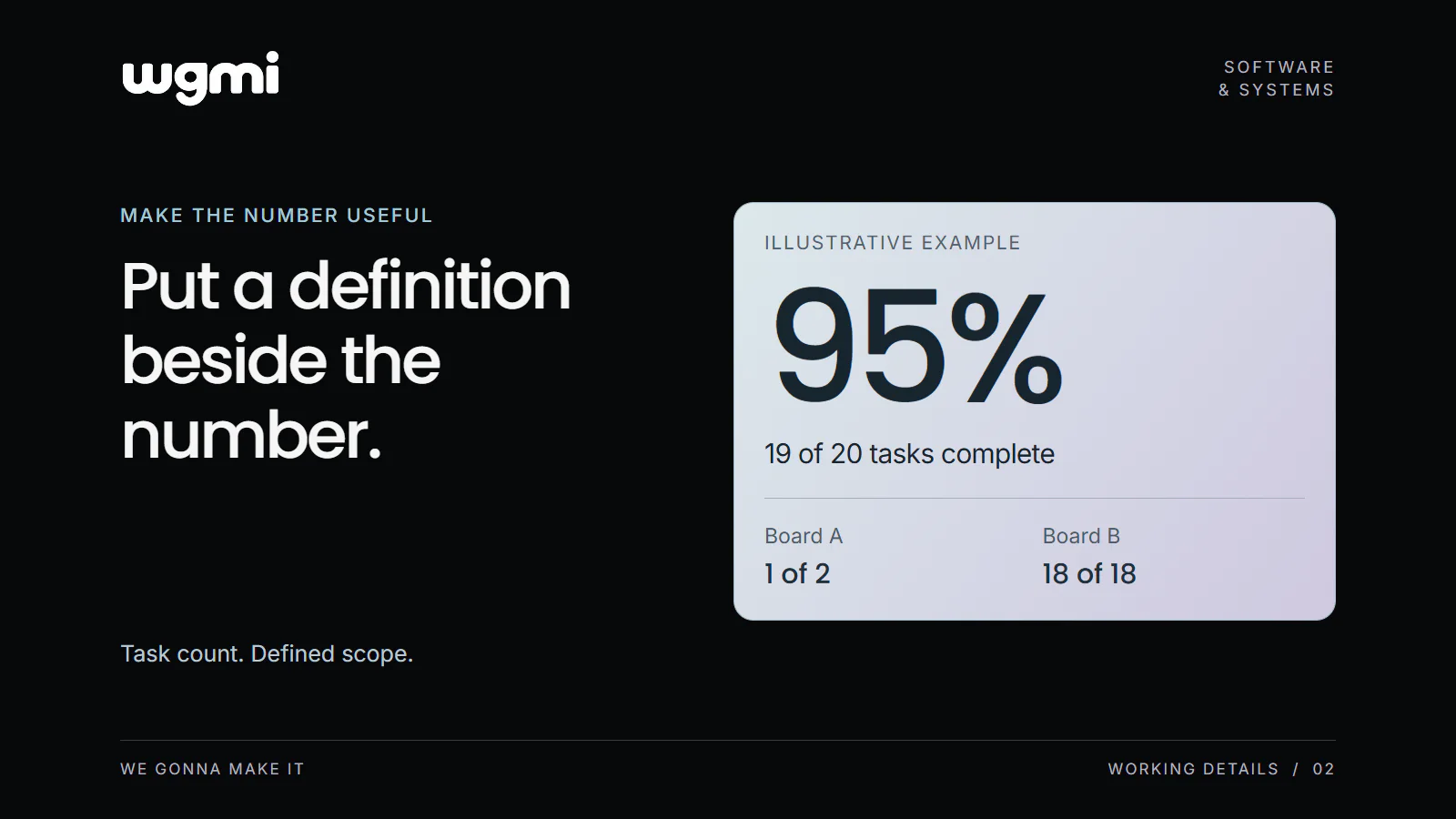
Two boards show 50% and 100% complete. You are preparing a progress update and need one overall figure. Averaging the two numbers is an understandable first move. Whether that answers your question depends on what you want the number to mean.
If the question is how many of all the tasks are done, you need the task counts behind both percentages. A small worked example makes the distinction visible.
Count the tasks behind the percentages
In this fictional example, Board A contains 2 tasks, with 1 done. Board B contains 18 tasks, with all 18 done. Their individual completion figures are 50% and 100%.
Across both boards, 19 of the 20 tasks are done. Dividing 19 by 20 and multiplying by 100 gives 95%. Averaging 50% and 100% gives 75%. Both calculations follow a rule, but the second gives each board equal weight regardless of its task count.
This is the distinction to settle before reporting a result. Does your figure describe the share of all tasks completed, or an average of board percentages? The label should let another person answer that without reconstructing the calculation.
One choice in our Taoro work
Taoro is our client operations project for small agencies. In our current design, the overall task completion figure adds the done counts and total counts across the included board rows, divides the combined done count by the combined total and rounds the percentage to a whole number.
That makes the overall percentage a task count measure. In the example above, the result would be 95%. It is a useful calculation when your question concerns completed tasks across the included work.
It also has a clear limit. A task count cannot tell you how many hours remain. The single unfinished task in the fictional example might involve a substantial piece of work, while some completed tasks might have been brief. We have supplied no estimates or time records, so the example supports no conclusion about remaining effort.
Give the number a definition
Our suggested reporting note records four things beside the result. These are fields for your explanation of a number, whether that explanation appears in an email, document or presentation.
What is counted. In this example, the numerator is 19 tasks marked done. That wording gives the count a meaning. If a team uses a particular rule for marking a task done, the reader needs to understand that rule too.
What it is divided by. The denominator is 20 total tasks. Writing it down prevents the percentage from hiding the size of the set. Nineteen completed tasks out of twenty tells the reader something that the percentage alone leaves out.
Which work is included. Here, the scope is Board A and Board B. A similar number that includes another board would describe a different set of work. Name the included work clearly enough that someone else can identify it.
When you checked. Record the date and time of your check. This identifies the observation behind your update. It does not, by itself, establish when every underlying record was last changed.
For the fictional example, the note could read: “19 of 20 tasks marked done across Boards A and B, checked at [date and time].” The bracketed part is for the person making the check to complete.
Match the question to the measure
With that definition beside the number, a reader can see what 95% means and where its meaning stops. If they need to plan staff time, they will need information about remaining effort. If they need to know whether the included tasks are marked done, this count addresses that narrower question.
The exercise works beyond this example. Before carrying a number into a decision, give the next reader enough information to interpret it. The calculation and the explanation belong together.
Write what is counted, its denominator, its scope and the time of your check beside one progress number in your next update.
Prepared for WGMI with AI assistance.