
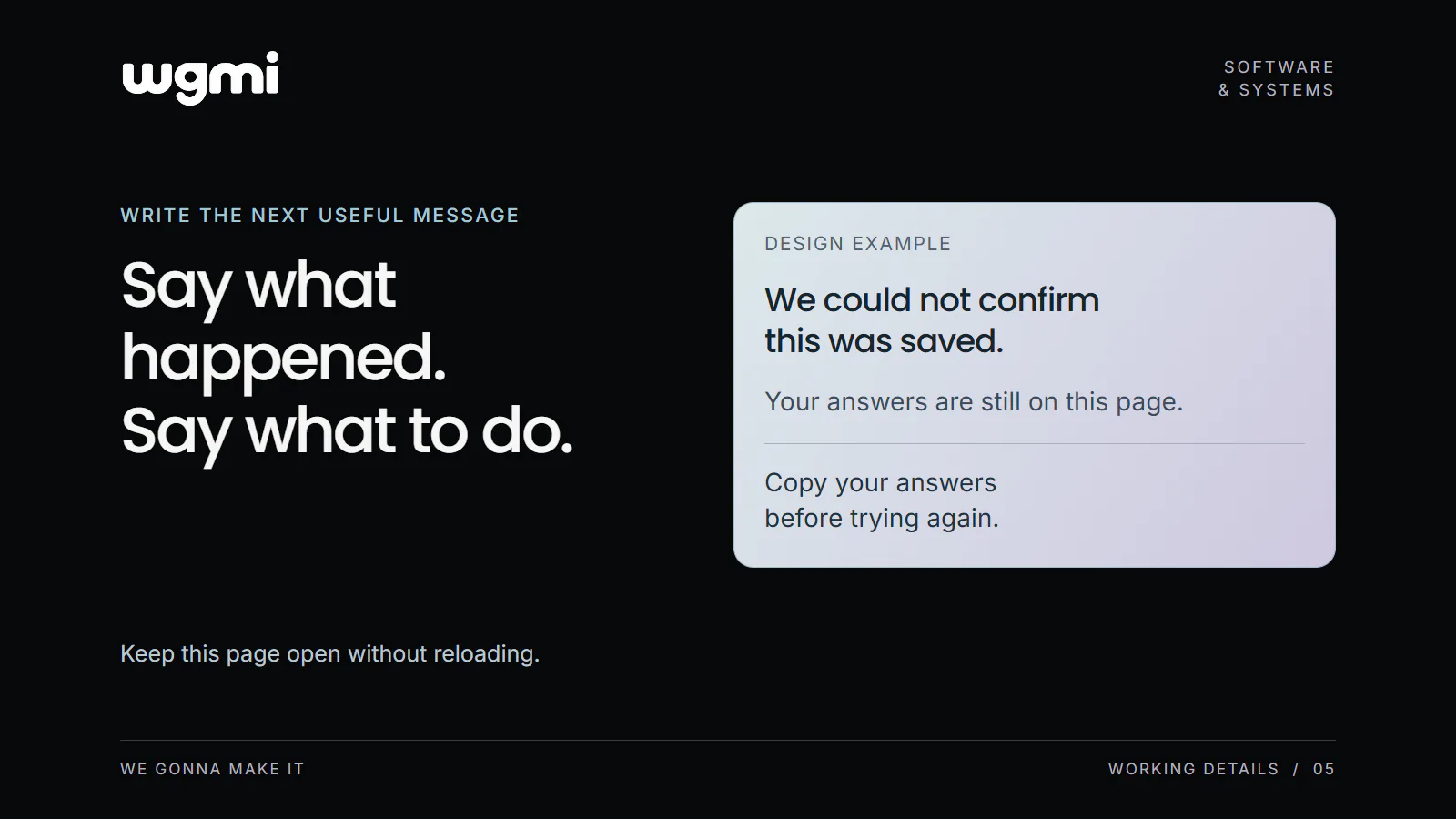
Say what happened. Say what to do.
Review a form error through three questions: what can be confirmed, what work remains available and which next action the person can take.
Someone has spent time explaining their business, checking a contact address and describing the work they need help with. They press send. The form displays "Something went wrong".
The person now has several unanswered questions. Was the message received? Are the answers still there? Is there something to correct? A friendlier apology can acknowledge the interruption, but those practical questions still need an answer.
Our suggested approach is to build the message around three parts: what the form can confirm, what work remains available and the next useful action. The wording needs to follow the behaviour you have actually established.
Start with what can be confirmed
In the WGMI brief design, a receipt appears only after a successful confirmation with a reference. If the send cannot be confirmed, the form says that it could not confirm the brief was saved. That wording keeps the uncertainty visible.
This distinction matters when reviewing your own form. A missing confirmation does not establish that the person entered an invalid answer. It also does not, by itself, establish whether the submission was stored. The message should describe the information available to the form at that moment.
An answer that needs correcting is a different situation. If an email address is incomplete, the message can identify the relevant field and explain the correction. A general submission problem needs wording that does not send the person searching through valid answers for an unspecified mistake.
Be precise about the work that remains
In the WGMI brief design, answers remain in the form after an unconfirmed send while you keep this page open without reloading. The form has no automatic saved draft for a later visit. That boundary belongs beside any reassurance about keeping the answers.
The phrase "Your answers are safe" could mean several things to a reader. They might expect to close the page, return tomorrow or continue from another device. If the form only holds their answers in the open page, the wording needs to say so.
Before promising that someone can return later, ask how that promise is supported. Where would the draft be kept? How would the person find it again? If those questions have no established answers, describe the narrower behaviour you can confirm.
Put the next action beside the explanation
A proposed message for the WGMI brief situation is:
"We could not confirm that your brief was saved. Your answers remain here while you keep this page open without reloading. Copy your answers before trying again."
The first sentence names the uncertain outcome. The second explains what the person can still use and for how long. The third suggests copying the answers somewhere they control before another attempt.
Someone following that suggestion could select their answers and copy them into a document they control. Review the actual page to check that the available controls let them preserve the text. For a different error that identifies an invalid answer, the next step should point to the field that needs attention.
Review the message in context
Choose one submission error and review it with the person maintaining the form. Establish the condition that triggers it, what happens to the answers and which controls remain available. Use a safe test with example answers rather than a real customer's details.
Read the message while looking at the page. Does the explanation name the relevant outcome? Does the reassurance describe the actual limit? Can someone follow the instruction without guessing where to go?
Keep a note of any mismatch between the words and the behaviour. If the form clears the answers, the copy cannot promise that they remain. That requires a product decision about preserving the work, followed by wording that accurately explains the result.
A useful revision may be only a few sentences. Its value is in giving the person an accurate account of the situation and a supported way to continue.
Rewrite one submission error using those three parts: confirmed state, available work and the next useful action.
Prepared for WGMI with AI assistance.