
Know what happens after the first enquiry
Use WGMI's contact and brief journey to understand the next action, useful context and commitment boundary before progressing with a technology partner.
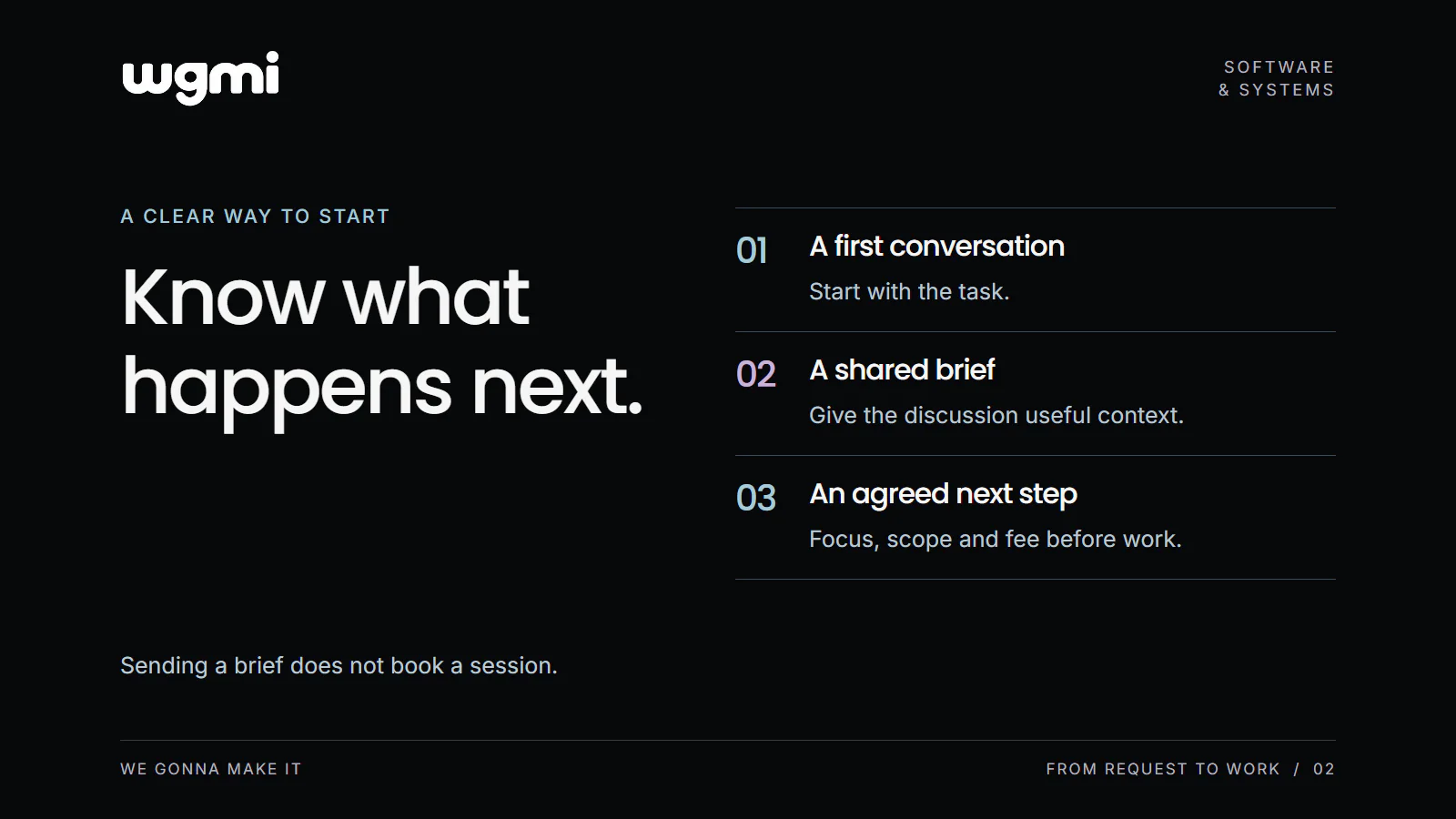
You have a task you would like to improve. It may involve a website, a working tool or a process that takes more effort than it should. Before contacting a potential partner, you may have a practical question: what happens after I send this?
The answer belongs in the enquiry path. Someone should be able to understand the next conversation, the information that will help it and the decisions that remain open. A button labelled Send cannot explain those things on its own.
Start with enough context for the next conversation
A useful introduction can describe one task, how it works today and what you would like to make possible. There may still be questions about the best approach. Those questions give the first conversation a purpose.
The amount of preparation should fit that purpose. If you already have a clear specification, it can help the discussion. If you have identified a difficult part of the work but have not chosen a solution, explaining that situation is useful context too.
The person receiving the enquiry also needs to know what they are expected to do with it. Are they preparing a first conversation, checking whether the task fits their work or reviewing an already agreed proposal? These are different next actions and deserve clear wording.
Where our shared brief fits
In the WGMI contact flow, the detailed brief is offered after a first conversation. The contact page invites people who have already spoken with us to put the task, current process and desired result in one place. They can complete it on their own or together with their WGMI contact.
The working brief presents a sequence: a first conversation, a shared starting point and a focused working session. Its role in that sequence is to collect useful context for the next discussion. It gives the people involved a common description to work from.
This also explains why a detailed brief does not need to be the first thing every visitor encounters. The enquiry and the shared brief serve different moments in the conversation. A short introduction can reveal which details deserve more attention next.
Make the commitment boundary explicit
The brief explains that sending it does not book a session or commit you to a purchase. That statement tells the person what their action means at this stage.
The next step described in the brief is to review the answers, confirm the focus and agree the scope and fee before work starts. Sharing information and agreeing the work are distinct decisions. The sequence makes room to discuss what is included and whether the proposed next step fits the task.
Before you progress with a team, look for the point where gathering context becomes agreeing work. If it is unclear, ask your contact which action begins the agreed stage. You can resolve that question before deciding whether to continue.
Use three questions before the next step
Our suggested check gives you three questions to take into your next enquiry. Look for the answers in the team's contact information, then ask your contact to clarify anything that remains open.
What happens next: What will the team do with the information you send? You might be preparing for an initial discussion or supplying context for a proposed working session. Understanding that action helps you decide whether it is the step you need.
What context is useful: What does the team need from you for that action? You can ask which details matter now and which questions can be resolved together. This keeps your preparation connected to a conversation you understand.
What still needs agreement: Which decisions remain open after you send the information? These might include the focus of a working session, the work it covers and its fee. Make the next decision clear before assuming the project has begun.
Read the explanation beside the action you are about to take. If a page seems to promise a booking but the confirmation describes an availability request, ask which one applies. The purpose is to understand your own next step.
A clear answer gives both sides a shared understanding of the conversation they are about to have. It also gives you a useful basis for deciding whether to proceed.
For your next enquiry, ask what happens next, what context is useful and what still needs agreement.
Prepared for WGMI with AI assistance.