
Who needs to be in the first project conversation?
Meet some of the people behind WGMI and use three questions to choose who should join an initial conversation about your next project.
You are planning a new website, a tool or an improvement to the way work gets done. Before a first conversation with a potential partner, there is a practical question: who should join you?
Our suggested starting point is three kinds of knowledge: the result you want, the task as it happens today, and the tools the solution needs to fit. One person may bring several of these perspectives. The invitation should follow the questions you need to answer.
A short introduction to our team
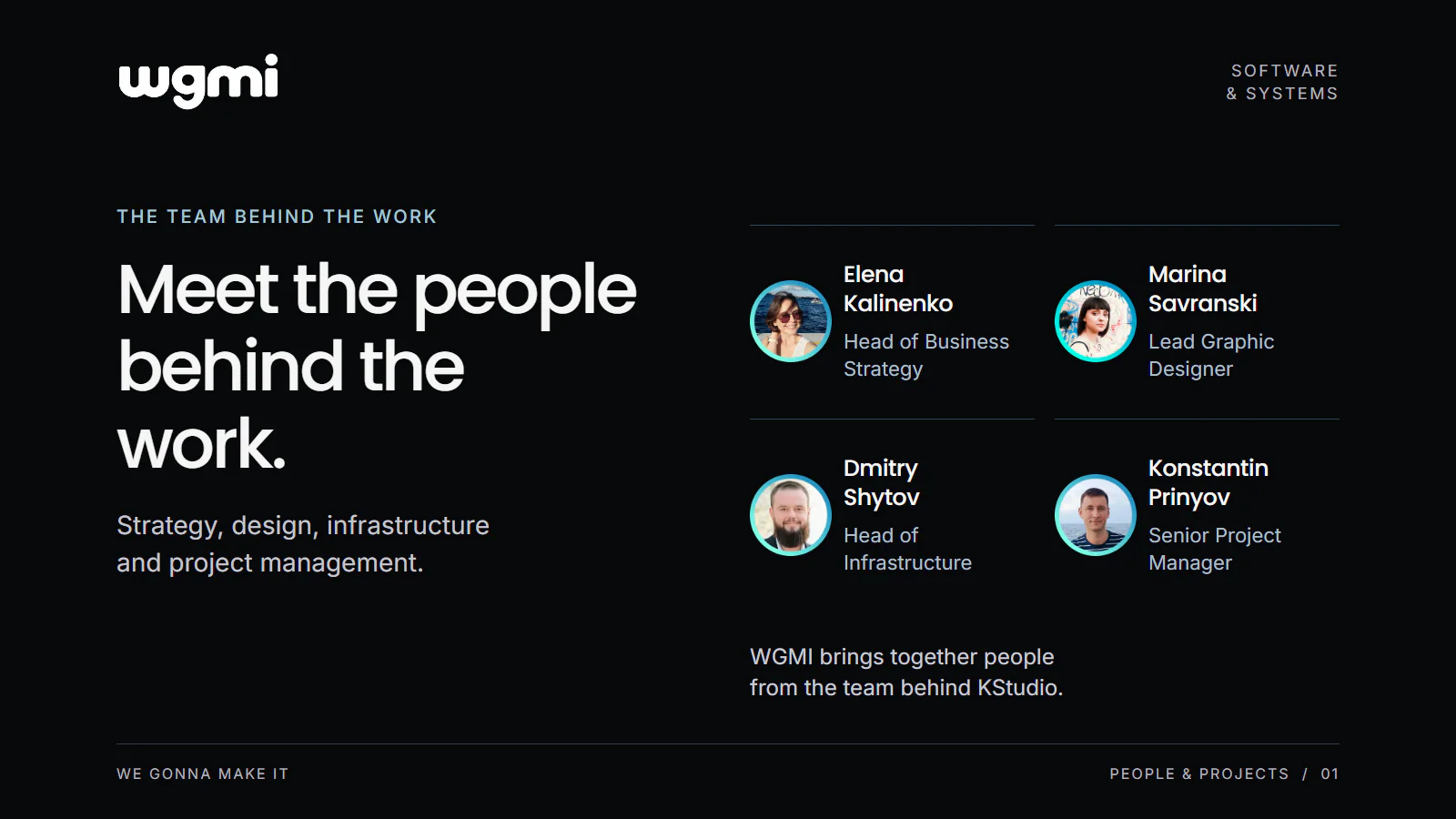
WGMI brings together people from the team behind KStudio. KStudio's creative work includes video, motion design, playable ads and product explainers. WGMI is your team's practical technology partner. We help you understand a task, choose a useful first step, build the solution and use it in your work.
Our team includes Elena Kalinenko, Head of Business Strategy; Dmitry Shytov, Head of Infrastructure; Marina Savranski, Lead Graphic Designer; and Konstantin Prinyov, Senior Project Manager. Participation is agreed for each task.
That gives you an introduction to the people and disciplines available for a conversation. The next useful question is what your particular project needs to resolve. A website's message, a software task and the constraints of an existing system may require different discussions.
Someone who can explain the goal
Start with the person who can say why this work matters now and what a useful result would look like. This might be a business owner, a team lead or the person responsible for a service.
Their contribution can be a plain sentence: what should someone be able to do when the project is complete? They should also be able to discuss priorities when the wish list contains more than the team can take on at once.
A proposed feature gives the conversation an object to discuss. Explaining the reason for it gives the group room to examine other ways of reaching the same result.
Someone who can show the daily task
Invite a person who actually carries out the relevant work. Ask them to bring one safe example, with personal or confidential information removed. They can walk through the steps and explain where they need to stop, look something up or ask someone else.
Here is a fictional planning example. A studio organises workshops and handles booking enquiries by email. The person answering those enquiries can bring a sample message with personal details removed and show how they check the requested date. This is an illustration of a conversation, not a completed WGMI project.
That walkthrough gives everyone something specific to discuss. The desired result could be letting visitors see available workshops and send a request. The team would still review each request and confirm the place. That scope opens useful questions about the information a visitor needs before enquiring.
Someone who knows the current tools
For that example, useful technical knowledge would include how the current website is edited and which calendar the team uses to check dates. A technical colleague may know those answers. The discussion can establish whether those tools can support the proposed approach and what still needs checking.
You do not need to settle every technical question during an introduction. Record what remains unknown and who can check it. If a decision depends on an existing system, the person who knows that system can help distinguish a known constraint from an assumption.
Write the invitation around one question
For the fictional workshop example, a meeting invitation could name the purpose as choosing how to present available workshops and receive requests. It could ask the goal owner to describe the visitor experience, the daily user to bring a sample enquiry and the technical colleague to explain the existing website and calendar.
Those requests give each participant a reason to attend. If someone only needs to answer one factual question, a written answer beforehand may be enough. Keep the invitation proportionate to the decision.
This is our suggested preparation for an initial discussion. The work and the people involved are agreed around the actual task. A useful starting point is something your team wants to make possible, together with an honest view of how it works today.
For your next project discussion, name who can explain the goal, demonstrate the daily task and answer questions about the current tools.
Prepared for WGMI with AI assistance.